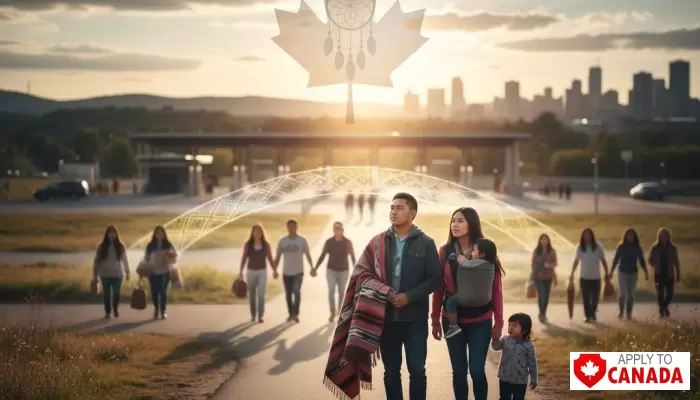
Supporting Indigenous Peoples’ Cross-Border Mobility
From: Immigration, Refugees and Citizenship Canada
Addressing the Impact of Colonial Borders
Colonial borders have significantly affected Indigenous communities, straining family bonds, cultural ties, and economic opportunities. For many, these challenges are a daily reality, especially for those separated by the Canada–US border.
Temporary Solutions for Reuniting Families
Measures Introduced by the Canadian Government
On October 10, 2024, the Honourable Marc Miller, Minister of Immigration, Refugees and Citizenship, unveiled temporary measures to assist Indigenous people in the US in reconnecting with their families in Canada. These initiatives aim to ease the hardships faced by those divided by the border.
- Eligible Indigenous individuals can work or study in Canada with certain requirements waived.
- Those already in Canada can extend their stay up to three years.
These measures are part of the ongoing commitment to implement the United Nations Declaration on the Rights of Indigenous Peoples (UN Declaration). Indigenous people can apply starting October 10, 2024, with applications required in advance. More details are available on the dedicated web page.
Voices from Key Leaders
“First Nations, Inuit, and Métis have long urged Canada to recognize Indigenous mobility rights across borders. These measures are a response to urgent family needs while we work to enhance these rights.”
– The Honourable Marc Miller, Minister of Immigration, Refugees and Citizenship
“Addressing border impacts is crucial for reconciliation. We are proud to partner with Indigenous communities to tackle these issues.”
– The Honourable Dominic LeBlanc, Minister of Public Safety, Democratic Institutions, and Intergovernmental Affairs
“These initiatives align with the Shared Priorities Measure 52 of the UN Declaration Act Action Plan, supporting Indigenous Peoples’ rights to maintain cross-border relationships.”
– The Honourable Arif Virani, Minister of Justice and Attorney General of Canada
Quick Facts on Indigenous Mobility
- The UN Declaration is a global instrument that sets standards for the protection of Indigenous Peoples’ rights. The UN Declaration Act became effective on June 21, 2021, guiding reconciliation efforts.
- Canada is working on legislative reforms to grant Indigenous people separated by borders the right to enter and stay in Canada, as outlined in Shared Priorities Measure 52.
- Roundtables and discussions were held to address Indigenous mobility issues, with findings available in an online report.
- The Government of Canada collaborates with Inuit Tapiriit Kanatami to expand measures addressing their unique circumstances.
Related Resources
- Temporary public policy to exempt certain Indigenous persons and their family members from temporary residence requirements
- Policy to exempt certain Indigenous persons from fees for temporary residence applications
- Ministerial Instructions for Temporary Resident Permits
Contact Information
For media inquiries only:
Aïssa Diop
Director of Communications
Minister’s Office
Immigration, Refugees and Citizenship Canada
Aissa.Diop@cic.gc.ca
Media Relations
Communications Sector
Immigration, Refugees and Citizenship Canada
613-952-1650
media@cic.gc.ca
Frequently Asked Questions
What is the UN Declaration Act?
The UN Declaration Act is a legislative framework that sets minimum standards for the survival, dignity, and well-being of Indigenous Peoples.
Who is eligible for the new measures?
Indigenous individuals in the US with family in Canada are eligible, provided they apply in advance.
How long can eligible individuals stay in Canada?
Eligible individuals already in Canada can extend their stay for up to three years.
Can applications be submitted at the border?
No, applications must be submitted in advance and cannot be processed at the border.
Where can I find more information?
Visit the official web page for detailed information on eligibility and application procedures.