
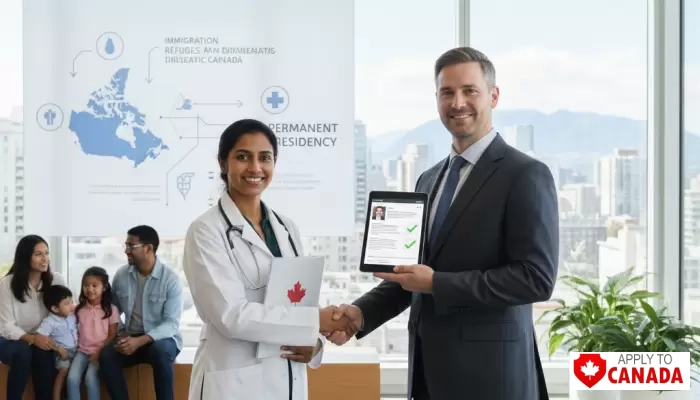
Easier Access to Permanent Residence for Physicians in Canada
From: Immigration, Refugees and Citizenship Canada
News Release
International doctors working in Canadian communities significantly contribute to our healthcare system, especially as our population ages. To address doctor shortages, the Canadian government is simplifying the process for these physicians to gain permanent residency.
September 23, 2022—New Glasgow, Nova Scotia—The Honourable Sean Fraser, Minister of Immigration, Refugees and Citizenship, announced new measures to help foreign-trained physicians remain in Canada and support our healthcare network. Some doctors encounter challenges with residency applications due to their self-employed status under the “fee-for-service” model.
To tackle this, IRCC will now exempt physicians working with public health authorities from certain requirements, recognizing their unique employment model. This change will enable more doctors to stay in Canada permanently, filling essential healthcare roles.
By enhancing the immigration system, Canada facilitates foreign nationals in staying and working, addressing labor shortages and boosting the economy. Collaboration with provincial partners continues to alleviate healthcare sector gaps.
Quotes
“Foreign-born physicians play a pivotal role in maintaining our community’s health. Their skills quickly integrate them as neighbors and leaders. These measures emphasize our commitment to making Canada their permanent home.”
– The Honourable Sean Fraser, Minister of Immigration, Refugees and Citizenship
“Today’s announcement highlights our dedication to retaining physicians in Nova Scotia. We applaud the federal efforts to remove barriers, complementing local initiatives like Healthy Pictou County.”
– Murray Hill, Chair of Citizens for a Healthy Pictou County
Quick Facts
- IRCC prioritizes temporary resident work permits for healthcare essential workers.
- In 2022, over 8,600 health sector applications were accepted for temporary and permanent residency.
- In 2021, over 2,500 specialized physician permits were extended, alongside 620 nurses and 550 aides.
- Since 2015, more than 22,400 individuals, including 3,600 physicians, gained permanent residency through Express Entry.
- Express Entry programs, like the Federal Skilled Worker Program, cater to physicians.
- By June 2022, approximately 4,300 permanent residents were accepted under the healthcare streams of the Temporary Residence to Permanent Residence Pathway.
- Canada is enhancing Express Entry to adapt to economic needs, with changes following Bill C-19.
Contacts
Contacts for media only
Aidan Strickland
Press Secretary
Minister’s Office, Immigration, Refugees and Citizenship Canada
Aidan.Strickland@cic.gc.ca
Media Relations
Communications Branch
Immigration, Refugees and Citizenship Canada
613-952-1650
media@cic.gc.ca
FAQs
How does the fee-for-service model impact physicians’ permanent residency applications?
The fee-for-service model classifies physicians as self-employed, posing challenges for meeting typical residency eligibility. Recent changes now exempt them from these specific requirements.
What is the significance of the changes announced for physicians?
The changes allow more physicians to gain permanent residency, securing their roles in Canada’s healthcare system and addressing critical shortages.
What other steps is Canada taking to address healthcare labor shortages?
Canada is prioritizing temporary resident work permits for healthcare workers and enhancing Express Entry to meet evolving economic needs.
Meta Description: Learn how Canada is easing permanent residency for international physicians to combat doctor shortages and strengthen healthcare services.