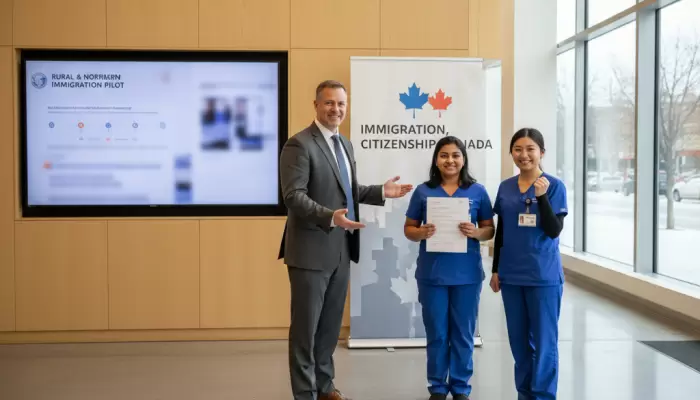
Enhanced Flexibility in Rural and Northern Immigration Pilot Welcomes Practical Nurses
From: Immigration, Refugees and Citizenship Canada
Ministerial Announcement on Rural and Northern Immigration Pilot
The Honourable Marco E. L. Mendicino, Minister of Immigration, Refugees and Citizenship, has introduced changes to the Rural and Northern Immigration Pilot (RNIP) to increase its flexibility. Alongside this announcement, the program welcomed its first two practical nurses to Sault Ste. Marie.
Program Modifications and Benefits
Adjustments to Work Experience Requirements
The RNIP is a community-led initiative aimed at extending the advantages of economic immigration to smaller communities by providing a pathway to permanent residency for skilled workers. Recent modifications now allow candidates to accumulate the required 1,560 hours of work experience over three years, even with employment gaps, rather than needing continuous employment.
This shift ensures candidates aren’t disadvantaged by short employment breaks, including those caused by the pandemic. Applicants must still meet all other entry and program requirements, including securing a recommendation from their chosen RNIP community.
Temporary Measures for Applicants
Immigration, Refugees and Citizenship Canada has also introduced a temporary measure allowing RNIP applicants, whose permanent residency applications are pending, to apply for work permits without being penalized for pandemic-related processing delays.
The first permanent residents under this Pilot, Alexander Nangpukin Likilasua and Brilla Mercy Kunjumon, are now serving as licensed practical nurses in Sault Ste. Marie.
Notable Quotes
“Newcomers have significantly contributed to our hospitals and long-term care homes during the pandemic, accounting for a substantial proportion of our healthcare workers. The Rural and Northern Immigration Pilot is essential in delivering skilled workers to communities like Sault Ste. Marie. We’re committed to ensuring immigration benefits reach every corner of Canada.”
– The Honourable Marco E. L. Mendicino, P.C., M.P., Minister of Immigration, Refugees and Citizenship
“Strong rural economies benefit all Canadians. Our government supports rural growth through investments in broadband, infrastructure, and immigration. The Rural and Northern Immigration Pilot will foster job creation and enhance Canada’s competitive edge.”
– The Honourable Maryam Monsef, P.C., M.P., Minister for Women and Gender Equality and Rural Economic Development
Key Facts
- One in four healthcare workers in Canada is an immigrant.
- 36% of pharmacists and family physicians, 39% of dentists, and 27% of licensed practical nurses in Canada are immigrants.
- Over 40% of newcomers in the healthcare sector from 2011 to 2016 worked in nursing and residential care facilities or home health-care services.
- Participating RNIP communities include Thunder Bay, Sault Ste. Marie, Sudbury, Timmins, North Bay, Ontario; Gretna-Rhineland-Altona-Plum Coulee, Brandon, Manitoba; Moose Jaw, Saskatchewan; Claresholm, Alberta; West Kootenay, Vernon, British Columbia.
- Communities are in charge of recruiting candidates and recommending them for permanent residence.
- RNIP exemplifies innovative community-focused immigration strategies, similar to the Atlantic Immigration Pilot and the Agri-Food Pilot.
- Note: Media can access photos at this link.
Related Resources
- Public Policy on Work Experience Eligibility Requirement for the Rural and Northern Immigration Pilot
- Backgrounder – Supporting middle class jobs in rural and northern communities through immigration
Useful Links
Contact Information
Alex Cohen
Minister’s Office
Immigration, Refugees and Citizenship Canada
613-954-1064
Media Relations
Communications Branch
Immigration, Refugees and Citizenship Canada
613-952-1650
IRCC.COMMMediaRelations-RelationsmediasCOMM.IRCC@cic.gc.ca